
So, to start… I realize that I actually haven’t written a travel journal entry in more than a year and a half. For that, I am truly sorry. Not that I haven’t traveled. I have gone back to the States and done a bit of travel here and there in Thailand. Also, I made trips down to Penang and Langkawi in Malaysia on a couple of occasions this year. Just nothing that I felt was worthy, really, of a write-up.
It has occurred to me that living abroad can actually start to make casual travel a bit ho-hum. For me, hopping on a van for a few hours and spending a weekend on a tropical island has become commonplace; flying up to Bangkok for a day or two as  middle-of-the-road as driving to Denver (assuming you live an hour or so from Denver). Unless I get a new stamp in my passport, it doesn’t really occur to me that anyone would be interested in reading about my travels. I know, I sound like a snob.
I will now attempt to redeem myself by regaling you with tips and tales of my travels in Vietnam…
VISAS—
It takes a bit more pre-planning to travel to Vietnam than some other countries. You don’t get a two-week or one-month visa on your passport alone. You do need to either retain one from an embassy outside the country ahead of time or apply for a visa-on-arrival through an online company. I chose the latter (http://www.tuanlinhtravel.com), as I had friends tell me it was a piece of cake. And they were right. You fill in your information, pay a $17 processing fee, and within 3 business days, you receive a letter of approval. Take this letter along with an application form (http://www.tuanlinhtravel.com/Vietnam/airport-visa-on-arrival-form.pdf), 2 passport photos, and $45 cash to the counter at your arrival airport in Vietnam and you are sorted.
SIDE NOTE: Although you will find information telling you that Vietnam uses both USD and VND, the dong is still king. Banks and exchanges also aren’t as readily available as in other countries such as, well, Thailand. Change your currency to VND at the airport or prior to arrival in Vietnam.
“When I was in ‘Nam…”: The information as to what you will need to secure your visa is very clear on the website, but apparently not clear enough for some people. An Aussie gentleman sitting in the waiting area seemed surprised by the instructions on the wall that told him he needed to pay for the visa. He thought that the $17 he paid online (processing fee, clearly stated) was the fee for the visa. As he pulled out his credit/debit card, I politely let him know that he needed to pay cash (also clearly stated on the instructions on the wall in front of him). He started rifling through his wallet for VND. I told him that it needed to be USD. Again, on the wall. Then he starts craning his neck looking for an ATM. The only one in the airport is outside the security area. Because Asia.
A gentleman from New Zealand was sitting next to him and offered to cover him, pulling $45 in crisp USD out of his wallet. The Aussie gent asked where he was staying so that he can pay him back. It happens to be that they are staying in the same hotel. A hotel where the seeming first-timer to Vietnam has actually stayed before. He starts telling NZ about the restaurants on this floor and that and things to do in Saigon. Really? You have been here before and even know where to eat and drink in Ho Chi Minh City, but you were unaware that you 1) needed to pay for your visa on arrival, and 2) that it needed to be in cash? Baffled.
DRIVING—
The first thing I noticed was that the steering wheels in their cars are properly situated on the left side of the vehicle and that they drive on the correct side of the road. By that, I mean, they drive on the right-hand side. Plenty of my UK friends would argue that this is the wrong side, but, hey, it’s called “right” for a reason, yeah? Bonus points for Vietnam.
SIDE NOTE: It is extremely common to see people wearing face masks while driving. These aren’t your garden variety, disposable paper masks. These are fitted cloth masks in different colors and patterns that cover enough of a person’s face to make the driver look like 50% of the characters in Mortal Kombat. Additionally, women may also be seen wearing driving skirts; basically, an ankle-length wrap skirt with Velcro in the waistband worn like an apron over their shorter skirt. Meant to keep clothes clean and make it a more modest drive to work. Combine this with a light jacket, sunglasses, and a helmet and you have your Vietnam driving uniform.
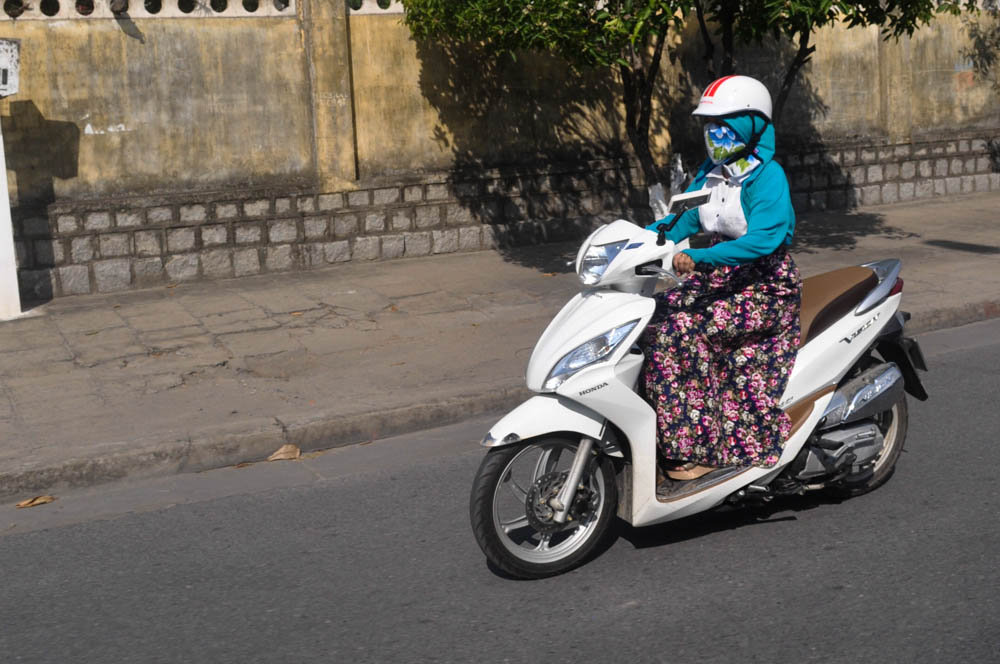
Nha Trang, Vietnam. A prime example of the Vietnamese “driving uniform”: driving, skirt, driving mask, hoodie, helmet.
I find driving in Thailand to be leisurely. Perhaps that’s not quite the right word to describe it, but I find that I can hop on my bike and get in traffic and not really have to worry so much about death. I can autopilot my way through Hat Yai. As long as I check over my shoulders before merging or turning, check all directions before running a red light, and stay far to the right with my blinker on when driving against traffic, I should be ok. And as much as traffic rules are broken quite regularly, basic courtesies are typically still observed by most drivers.
This is not so much the case in Vietnam.
Head on a swivel. Constantly check and recheck before making any turns (and even sometimes that doesn’t save you from the person who decides to try to pass on your left while you are executing said left turn). Navigating a round-about in a not-so-round-about manner because no one seems to have ever been taught how to use one. And knowing that the person driving against traffic will most likely drive directly towards you across traffic, on YOUR side of the road where YOU have the right of way, and expect YOU to get out of THEIR way.
“When I was in ‘Nam…”: One sunny afternoon, my friend and I were driving to the store. We were having casual conversation and the traffic was fairly light. We both noticed the gentleman driving towards us, against and across traffic, with three other people on his bike. He wasn’t going particularly fast, nor was traffic. We were able to move a bit to the right to go around him as he passed through, but the person to our left wasn’t as lucky. With nowhere to go and with the oncoming driver doing nothing to divert his course or avoid colliding, they did, in fact, collide. Head on. We heard the crunch of plastic as we narrowly escaped being victims ourselves. It all happened in slow motion. Not like perceived slow motion, but honest-to-goodness, this-crash-is-easily-avoidable slow motion (think Austin Powers with the steamroller). All we could do was to laugh in disbelief and say “Did that really just happen?” as we carried on our way.
And, finally, The Honking Horns… Dear God, the horns. There is a constant sound of horns being honked. They do it when they are passing or want to pass. They do it going around corners. They do it when they think someone six car lengths away *might* get in front of them. They do it when you are on a bridge with nowhere to go and a car directly in front of you and they want to be the person directly behind *that* car. They do it because it’s a day ending in ‘y’.
Thailand now seems library-quiet to me.
 Life Thru A Lens Photography